DevClaw turns every Telegram group into an autonomous dev team. Create issues, go to sleep, wake up to completed work. DEV writes code. QA reviews it. Failures loop back automatically.
Every task involves 10+ coordinated steps. Agents follow them imperfectly. The more steps, the more things break. You end up babysitting the thing you built to avoid babysitting.
Label transitioned but state didn't update. Session spawned but audit log didn't write. Now you have inconsistent state and an agent trying to figure out what went wrong — which it will do poorly.
Every new sub-agent session reads the entire codebase from scratch. A huge chunk of token usage isn't even coding — it's the agent reasoning about "what should I do next."
Sessions die, workers get stuck, state drifts. Active worker with a dead session. Worker stuck for hours. Orphaned references nobody cleans up.
Opus for a CSS typo. Haiku for a database migration. Without automatic model selection, you're either overpaying or under-delivering on every task.
Don't make the agent responsible for process. Move orchestration into deterministic code. The agent provides intent. Tooling handles mechanics. One atomic tool call replaces a 10-step agent checklist.
Agents pick up issues, write code, create PRs, and loop through review — all visible in your group chat. The issue board updates itself.
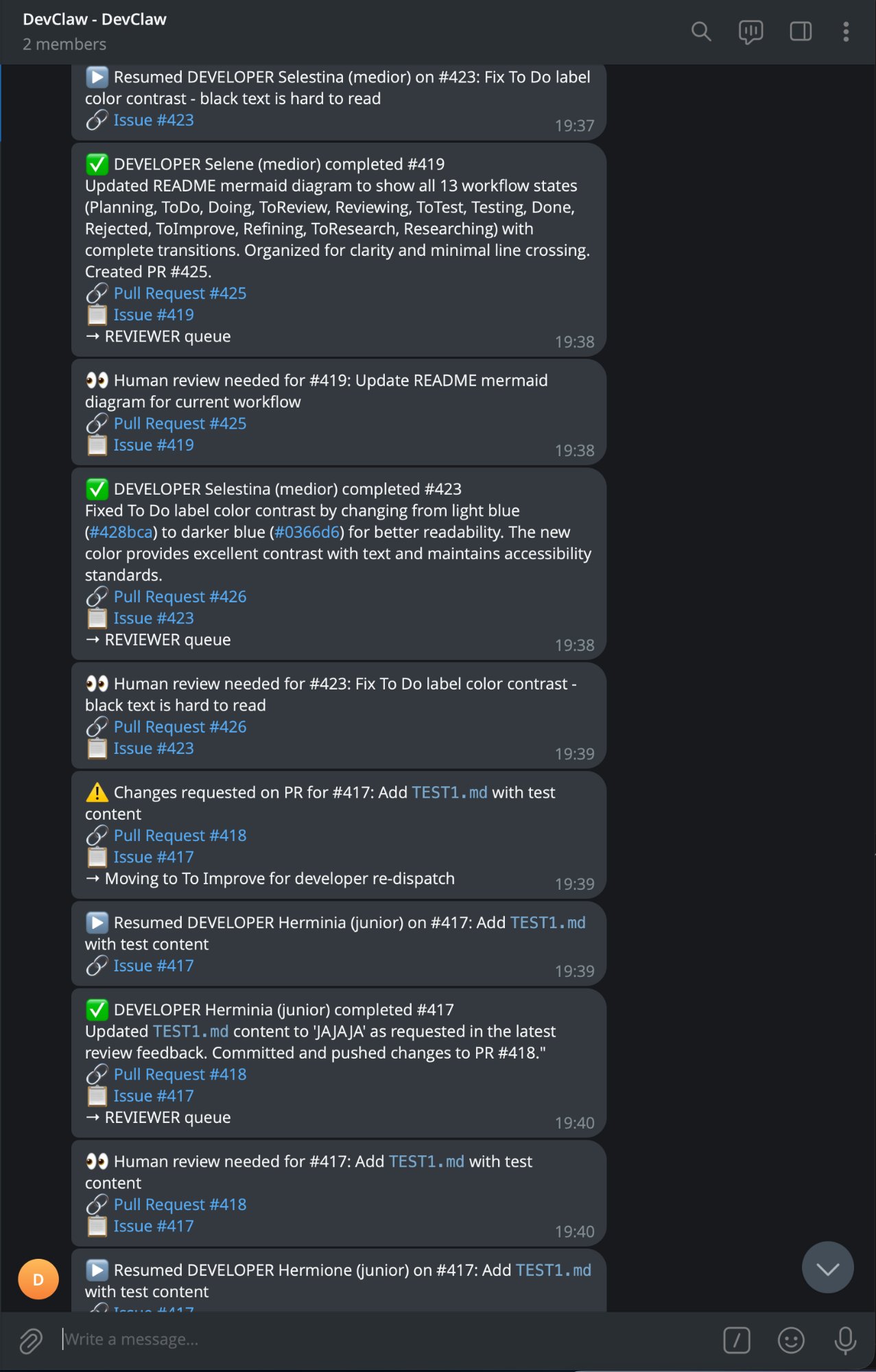
DEV agents complete tasks, QA flags reviews, failures loop back — all autonomous
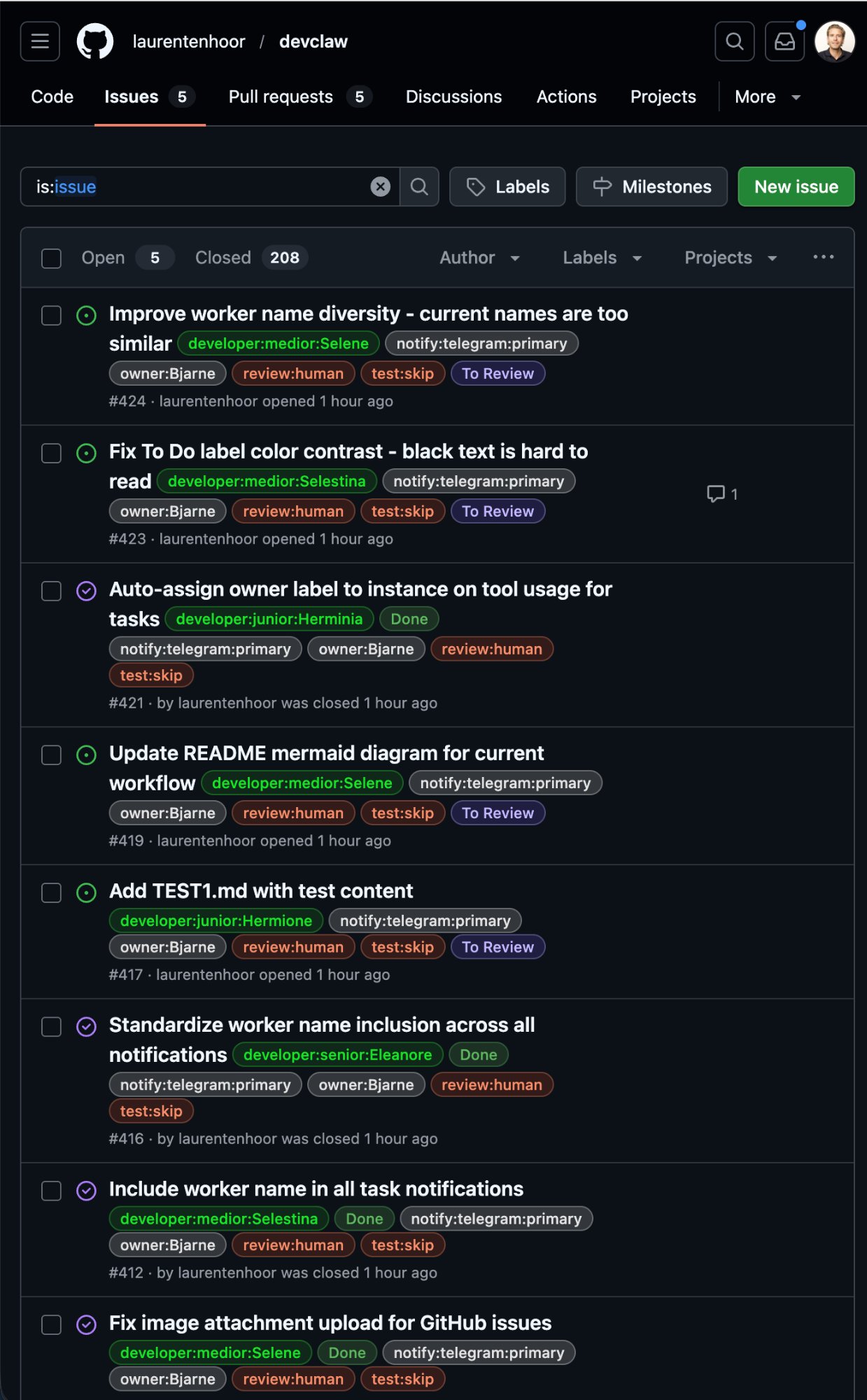
208 issues closed. Junior, medior, senior labels auto-assigned by complexity
Each Telegram group is a separate project. Own queue, workers, session state. The moment projects share anything, you get cross-contamination. DevClaw prevents that by design.
Every operation that touches multiple things succeeds or fails as a unit. Label, state, session, audit log — all in one call. Roll back on any failure. No partial state corruption.
When a DEV finishes task A and task B is waiting, it goes to the existing session. The worker already knows the codebase. No 50K token re-read. Massive savings on sequential tasks.
Haiku for typos. Sonnet for features. Opus for architecture. The right model for every task, selected automatically by complexity. Override anytime with modelOverride.
A heartbeat scans queues and dispatches tasks through pure CLI calls. Zero LLM tokens burned on "what should I do next." The model only activates when there's code to write.
Automated detection for zombies, stale state, and orphaned references. Auto-fix the straightforward cases, flag the ambiguous ones. Your pipeline recovers without you.
Model tiering, session reuse, and token-free scheduling compound to massive savings. But the real win is reliability — across multiple projects, simultaneously.
A CSS typo doesn't need your most expensive developer. A database migration shouldn't go to the intern.
Without atomic state management you are just funding expensive zombie sessions.
Community feedback on Reddit — validating the guardrails-as-code approach
DevClaw is open source, MIT licensed, and built on OpenClaw. Install it, point it at a repo, and let your agents do the work.